The Cretan Dagger, Characteristics and Manufacturing
Part 2
The typical Cretan dagger with the form it preserved todate was born in the late 18th century and has a shape reminding of a dart. Its distinct shape was adopted by the Cretans with enthusiasm and resisted the course of time.
Fire, anvil, steel, hammer, long-handled pliers and the dagger -manufacturer’s dexterity are the necessary elements for manufacturing the Cretan dagger. Its steel blade is sturdy and has only one edge, while the side opposite to the edge, the dagger’s “back”, is flat, reinforced in its base and it grows gradually thinner on approaching the tip, ending at a very sharp point.
The blade’s shape is straight; the side of the edge, a little before the end of the blade, curves sharply and ends at the point, which has a slight upward gradient. The blade’s length varies. In the mid -19th century Cretan dagger manufacturers fabricated oversized daggers, the length of which could reach 80 cm. These huge daggers could be used as sabres too.
The manufacturing singularity of the Cretan dagger’s point endows it with great penetrability. The part of the dagger opposite to its pointed part is called “root” and this is where the hilt was fixed, earlier with six pins (pertsinia), today with only three.
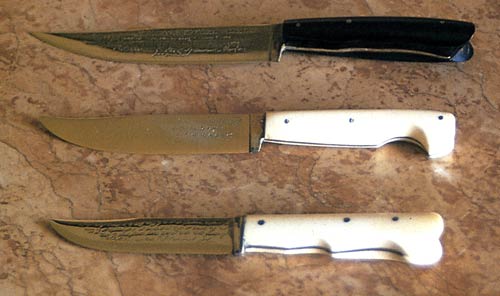
The Cretan dagger’s hilt is called “manika”. Its shape varies. However, three are the dominant types. In the first the hilt’s end resembles a bird’s beak, in the second the shape of the hilt’s end is the same as in the 18th and 19th century cutlasses and in the third, which is the classical Cretan type, the hilt’s end is V -shaped.
The V- shaped hilt is the most common and appears only in Cretan daggers, endowing them with a singularity of type, since in no other place in the world are daggers with a hilt of similar shape manufactured.
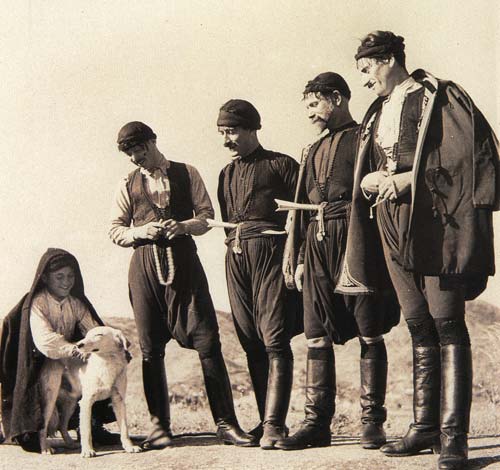
This peculiar hilt is always made of animal matter, horn or bone, while in the most lavishly manufactured daggers it is made of ivory. Hilts which are not made of this precious material are made of white bone, derived mainly from ox feet, which the dagger manufacturers, even today, boil in a mixture of water, ash and lime for about five hours, exactly as they used to do two centuries ago, so that it will acquire a bright white colour, and then they grind it before using it.
More rarely, however, daggers had deep- coloured hilts made of horn.
The numerous flocks of sheep and goats of Crete and the stout horns of its buffaloes still provide today ample raw material for the horn-made hilts of daggers, while, more rarely, hilts are made from the island’s wild goats’ horns, known as kri – kri.
The stoutest and most durable horns for making hilts are the ram’s and the billy-goat’s. Among ram horns they prefer the “gold – coloured ones, with undulations”, while buffalo horns are more glossy and lustrous, but they wear out faster than ram horns.
Dagger – manufacturers leave nothing to chance. They choose carefully the animal horns that they will use for making the manikes (hilts). They mainly prefer those of male animals, which thus offer their horn weapons for the manufacturing and embellishment of human weapons.
Daggers with dark – coloured hilts are called mavromanika. Each bone or horn suffices for only one hilt.
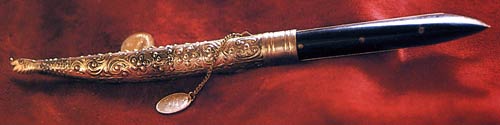
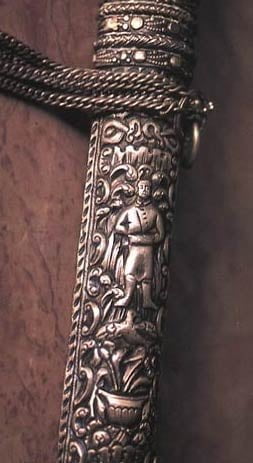
Great aesthetic value lies in the silver “foukaria” (scabbards) of the silver-sheathed daggers. The distinct perfection of the Cretan silversmiths’ art is concentrated in these objects. The same holds good for their singular artistic expression, manifested in a vivid and expressive manner on the cylindrical surfaces of the daggers’ silver scabbards.
- The Cretan Dagger, Part 1: the knife of Crete
- The Cretan Dagger, Part 2: Description & manufacturing of the Cretan Dagger
- The Cretan Dagger, Part 3: The Cretan Dagger in manners, habits, popular beliefs and magical ceremonies
“The Cretan Dagger “
Nikos Vasilatos
Classic Editions
ISBN 960-220-470-2
tel. +30-210 3639418
email: N. Vasilatos
© explorecrete.com All Rights Reserved. Reproduction or copying without permission is prohibited.