Greek Gestures
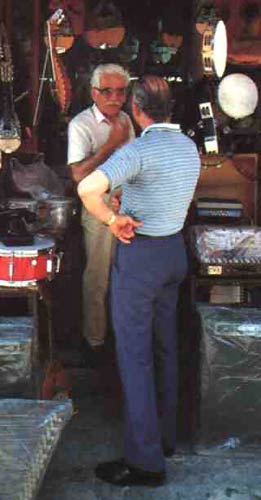
Greeks are renowned in the Mediterranean for their extensive use of gestures. Their expressive use of hands, bodies, and faces means that often, you can grasp the main points of a conversation just by observing from 50 meters away.
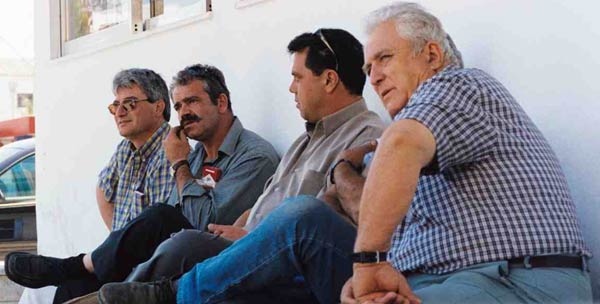
Here are some Greek gestures and their interpretations:
“No”
Instead of shaking heads from side to side as we do, they have another indescribable way of saying “No”. This is done by raising the entire head in a backwards movement and clicking the tongue.
Sometimes these movements are too subtle and quick, and you can’t be too sure that he/she’s answered at all. You can repeat the question again and again, and find he/she’s been saying “No” from the very beginning.
“Yes”
A slow down movement of the head to one side, slightly closing the eyes as the head is lowered.
“Come here”
This gesture is indicated by the wawing of the hand, a kind of pawing of the air with the fingers and the palm downwards, that looks to the non-Greek as though he/she is either waving good-bye, or telling you to move back a few steps.
This can be confusing, because the further you move back, the more frantic the gesture becomes.
“I want to tell you something”
This gesture is done by touching or patting the lower lip with the index finger, and can easily be misunderstood, as it looks as if you are being told to be quiet.
This gesture is often performed immediately after the “Come here” gesture – and put together they simply mean “Come here, I want to tell you something”.
“What do you want / what do you mean?”
With a quizzical expression in his/her eyes, the Greek will shake his/her head from side to side a few times. This normally means that he/she either hasn’t understood what you’ve asked, and is asking you to repeat it, or he/she is asking you what you want.
“Thank you very much my friend”
The “Yes” gesture is followed by putting the right hand to the heart. Standing in front of the person, the gesture is of course followed by a verbal statement. But the gesture can also be performed at some distance.
Mountza – Open Palm Gesture
When someone extends his hand towards another person with his palm open and fingers spread, that’s the famous Greek “mountza” gesture.
It is not a kind gesture and you shouldn’t try it yourself ! The mountza is a serious insult in Greece, and people can get very annoyed by this “medal of open palm”, as Greeks call it ironically.
Mountza is also known as “faskelo“, and it can be single (with one hand) or double (with both hands). It is believed it originates from the Byzantium, when the judge used his hands to apply ash or cinder (mountzos in Byzantine Greek, mountzoura in modern Greek) on the criminals’ faces.
Article by Birgit Smidt Sneftrup and Bo Transbol
Read also: Greek Customs and Habits
© explorecrete.com All Rights Reserved. Reproduction or copying without permission is prohibited.