Apokries (Carnival) in Crete and Greece
Apokries or Carnival, the festival of fun and masquerade for young and old. What else could you expect of a festival that comes down to us from the ancient worship of Dionysus in Greece?
It’s no coincidence that Dionysus is the god of wine. Wine loosens inhibitions and brings a mellow, cheerful mood that reaches its peak in the Christian world a few days before people begin the long fast of Lent.
During the 40-day Lenten fast in Greece, people eat no meat or animal products. This is why the three weeks before Easter are called Apokries, i.e. “abstention from meat”. The same applies to the word “carnival”, from the Latin carne (flesh) and vale (farewell) [or otherwise carn- (flesh) and levare (put away)].
At Great Carnival time
Poem by Kostas Frangoulis
Even grannies go crazy
So do the old men too,
Remembering the days they
Were free as birds and flew.
So what if they’re old women?
So what if they’re old men?
Age never touches people’s hearts
For they are always young.
History of Carnival in Greece
According to current thinking, carnival has its roots in ancient ceremonies meant to help the earth put forth shoots. The magical aid took the form of leaping dances and various kinds of folk mummery and disguise, in order to propitiate harmful spirits. Down the centuries some of the ancient ceremonies and traditions have been lost, but most have been incorporated into the Christian religion and taken on a different meaning.
In ancient Greece, the festival in honour of Dionysus took place in early Spring, as Dionysus symbolised life’s rebirth after Winter. Today, carnival is held in the same period but not on a fixed date, as it depends on the moveable feast of Easter.
How people celebrate during the Apokries
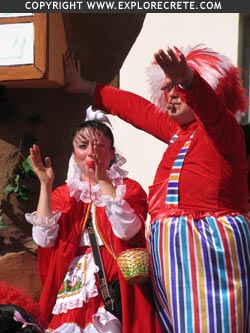
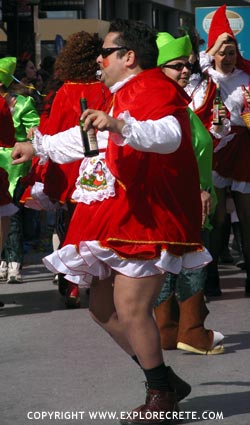
During carnival people dress up and enjoy the freedom of anonymity. Carnival celebrations today are much more decorous than the ancient Dionysiac revelry, when the followers of the god ran through the streets brandishing giant phalluses and singing rude songs. However, masks let their wearers lose their serious and respectable selves and have fun, forgetting their worries and problems.
The mask is thought to be a descendant of the ancient identical clay masks worn by actors in ancient Greek comedy and satyrical drama. Then the Romans made many different masks representing the various types of comedy. Many centuries later, in Northern Italy, the commedia dell’arte was developed, introducing the characters of Harlequin and Columbine with their respective masks and guises, and also golden bird-masks.
Carnival Events in Greece
The word “carnival” may bring to mind the Carnival of Rio in Brazil or the Carnival of Venice in Italy, but there are also important Carnival events taking place in Greece. The most famous is the Carnival of Patras in the Peloponnese, while the Carnival of Rethymnon is becoming more popular and better organised every year.
Another popular Cretan carnival parade is the one in Malia, which is also getting better every year. The case of Heraklion Carnival is perhaps unique in Greece; its carnival was famous at the turn of the 20th century, but gradually declined. Since 2000, the city authorities have been trying to revive it and it is getting better every year.
Carnival Traditions
- During the second week of Apokries, known as “Kreatini” (Meat Week), meat may be eaten every day, even the traditional fast days of Wednesday and Friday.
- The Thursday of the second week of carnival is known as “Tsiknopempti” (Tsikna Thursday). This is when the festivities begin. Traditionally, everyone must cook meat so that the smoke or “tsikna” fills the air and everybody knows it’s a feast-day. That’s how Tsiknopempti got its name.
- On Tsiknopempti the first masqueraders make their appearance and the first carnival parties are held. The bars and clubs are packed, especially in the towns. There are all kinds of costume and you can hire the one you prefer. Today you will see incredibly ugly women on the streets. Have Greek women suddenly become unsightly? No, it’s just that lots of men dress up as women, with hilarious results.
- The third week is called “Tyrini” (Cheese Week) – people can eat dairy products and fish but not meat.
- Apokria ends on “Kathari Deftera” (Clean Monday), the first day of Lent, the 40-day fast until Easter Sunday. On Clean Monday, the “koulouma” are held. Everybody goes off to the countryside, eats Lenten food and flies kites. People used to make their own kites and it took a lot of skill to make your kite fly higher than the rest.
Halvas, the Apokries sweet
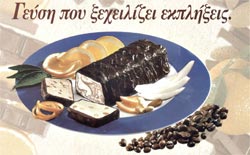
For Greeks, halvas is a Lenten sweet, especially the type made with tahini and sold in cylindrical or rectangular form. This type is called Macedonian Halva. It is sold by weight and is also available with chocolate or walnuts.
© explorecrete.com All Rights Reserved. Reproduction or copying without permission is prohibited.